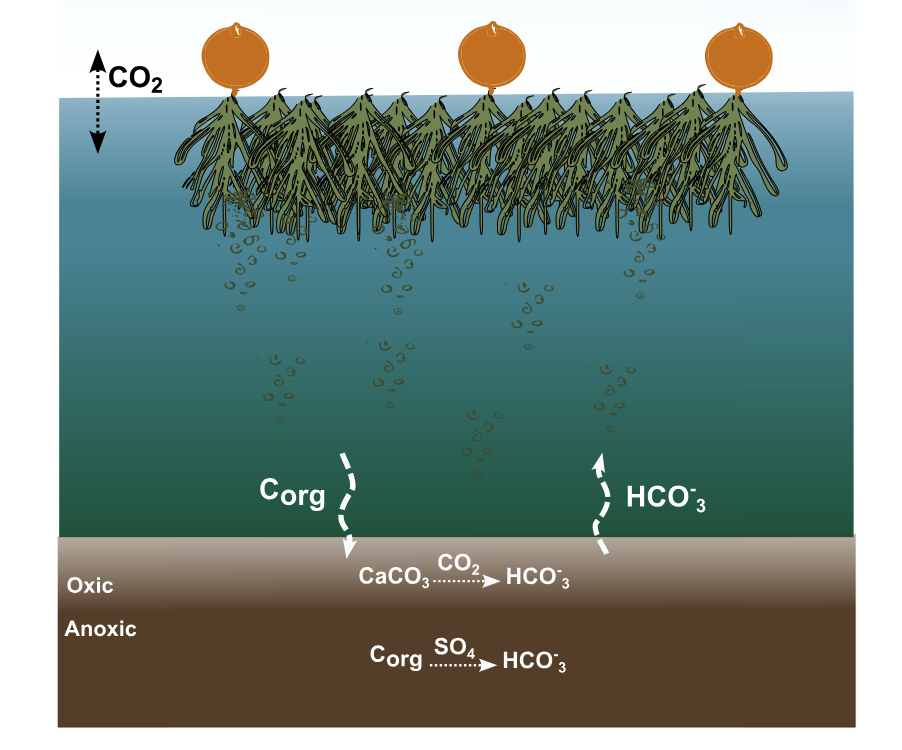
Seaweed farms are highly efficient at removing atmospheric CO₂ because seaweed grows rapidly and converts carbon into biomass, but their long-term storage potential has often been underestimated. New research published in Nature Communications Sustainability by Department of Earth Sciences Assistant Professor Mojtaba Fakhraee challenge the assumption that this carbon is quickly released back as CO₂, identifying an overlooked process in seafloor sediments beneath seaweed farms. In low-oxygen conditions, microbes transform organic matter into bicarbonate, which increases ocean alkalinity and alters water chemistry in a way that promotes additional CO₂ uptake. This process enables more durable carbon sequestration, potentially locking carbon away for thousands of years. As a result, seaweed aquaculture emerges as a scalable, sustainable solution.